Showing posts with label norton scientific cyber crime fraud. Show all posts

Monday, March 12, 2012

Scary cybercrime headlines: Fraud surveys helping consumers or selling brands?


British Columbians are worried about cybersecurity  but they’re also more likely than other Canadians to share their debit card personal identification numbers with others and take other risks that could leave them open to identity theft and other fraud.
Scary cybercrime headlines: Fraud surveys helping consumers or selling brands?
These are among the findings of a survey released today by TD Canada Trust in conjunction with Fraud Prevention Month in Canada.

Visa Canada released its own survey, this one conducted by Ipsos Reid that found young Canadians, those aged 18 to 30 are the most likely to share too much personal information on social networking sites — information such as birthdates, home addresses and phone numbers that provide lucrative pickings for identity thieves, phishing expeditions and other online fraud.

Today’s releases come the week after Norton, the security company, released its top riskiest Canadian cities for cybercrime risk rankings. The polls and rankings all add up to a lot of scary headlines and ones  Simon Fraser University communication professor Peter Chow-White suggest may be designed more for advertising and brand awareness than for research.

“I think it is to put a discourse of anxiety and fear into the public sphere,” he said. “They are all framed around risk, not safety.”
Chow-White suggests the practice of companies commissioning surveys and circulating them amongst the media creates a sense of insecurity and anxiety about online security.

“That’s what advertising does,” he said. “It’s trying to create a sense of anxiety amongst people for needing to do something, whether it’s white teeth, new tires or anything.

“This is just another episode in the long history of advertisers and companies creating market share, creating a market for their products.”

Chow-White points out that in all the survey press releases, the tips or suggestions for cyber security mostly lead back to the company that commissioned the survey.

Chow-White is of course right. We in the media hardly ever see  a survey we resist reporting on. And while some are of the heavily academic and scientific variety, able to withstand the scrutiny of  peer review, others are hardly more scientific than the ‘what do you think of this’ polls that I sometimes put on blog posts and still others fall somewhere in between.

Newsrooms get press releases trumpeting survey results pretty much on a daily basis. Some are tried and true favourites — like the one that measures how many people text from the bathroom, a tired headline but one that nonetheless is paraded out perennially. Or this year’s variation from eBay promoting eBay as a holiday shopping source:” “Did you know your friends were buying presents in the bathroom?”
Depending on the editor and whether it’s a slow news day, surveys get picked up and make headlines in media both online and off.

Do they serve a purpose other than to build brand awareness or provide fodder for techno trivia?

I thought about that as I considered today’s releases from Canada Trust and Visa Canada. Are surveys about the risk of fraud prompting people to pay more attention to their security, both online and off?

According to TD Canada Trust’s poll more British Columbian’s are taking steps to protect themselves from traditional forms of fraud, but there’s no telling whether it because they’ve been reading stories from such survey results. Some 86 per cent of people shield their PINs at banking machines compared to 77 per cent last year. I know I do ever since I wrote a story about fraudsters installing temporary cameras at ATMs to capture your PIN as your punch it in.

Some 27 per cent have spoken to their bank about reducing their withdrawal limit compared to 19 per cent who said that last year. In my case I lowered the limit on a credit card not because I read the stats but because I was the victim of credit card fraud — a circumstance that may lead many consumers to rethink their security measures.

However, the anxiety over risk hasn’t reached everyone in British Columbia. We’re the most likely of any consumers in Canada to carry our debit or credit card PIN in a wallet along with the card. Clearly we’re not frightened enough by the stats.

Visa Canada’s survey was also all about risk. Not surprisingly seniors were the least likely to engage in risky online behaviour — at least when it comes to over sharing – while young adults were most likely to take those risks. Young adults are also most likely to lend their bank or debit card to others.

What do you think? Should surveys commissioned by companies be consigned to the junk filter or do you think they serve a purpose?

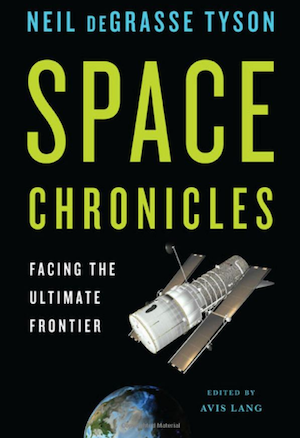
Neil deGrasse Tyson pushes exploration in Space Chronicles

Plans for NASA have seen some large swings in recent years. First came President Bush’s   ambitious vision for a return to the Moon with a new spacecraft. Then it was President Obama’s
 reorganization of the space program, hastening the retirement of low Earth orbit vehicles and opening the door to the private sector. Over the past few months, NASA has been struggling to defend funding for various projects as budget cuts are being considered in the political arena. Being buffeted by the winds of political change has become standard operating procedure for NASA.

Neil deGrasse Tyson pushes exploration in <em>Space Chronicles</em>That’s one of the themes of Neil deGrasse Tyson’s new book, Space Chronicles: Facing the Ultimate Frontier. Tyson, an astrophysicist and director of the Hayden Planetarium at the American Museum of Natural History in New York, has become a celebrity face of American science—and for good reason. He has an easy-going, good-humored demeanor and he knows how to talk to the public, not just in a way people will understand, but in a way that makes them care.


 He has an infectious passion and  optimism for science, and he’s always having fun. He just makes you want to get on his team.

In Space Chronicles, Tyson makes a compelling case that NASA's budget represents a critical investment that has been neglected for some time. He suggests we haven't really had to make that case before, because the utility of that investment has really never been a factor in funding decisions—science and societal benefit have always taken a back seat to maintaining the appearance of American primacy. JFK pointed the United States to the Moon because it was unacceptable to let the Soviet Union get there first. Now, Tyson worries, the US won’t get serious about Mars until the Chinese vow to get there first..


The book is a collection of essays and speeches, along with several interviews, all organized under three themes: Why? How? and Why Not? That is, the motivation for ambitious space exploration, the logistics of such projects, and the major obstacles that stymie progress.


Making the case for space

Tyson doesn’t just point to curiosity about the Universe. We all want to know if there’s life out there, and most of us get a kick out of discovering the science non-fiction of far-away worlds. But philosophical and intellectual pursuits often don’t play well at the bargaining table, so Tyson wants to sell the tangible, material benefits. 

There’s always the option of appealing to blatant self-interest by discussing impending doom via asteroid collision. If you’d rather accentuate the positive, though, there are technological spin-offs. (Don’t think Tang and space pens; think mammogram image processing techniques that arose from attempts to deal with Hubble’s initially distorted optics.) Tyson makes the case that these spin-offs are not just coincidental benefits that could have been achieved much more efficiently through direct research. They’re the unexpected results that come from interdisciplinary collaboration on ambitious goals—what he refers to as "cross-pollination." Good things happen when the best and brightest come together to push the envelope.
More generally, Tyson sees manned space exploration as one way to make sure that the best and brightest end up in science in the first place. The Moon landing inspired an entire generation of researchers and engineers. How do we grab another generation of young minds and turn them loose on the future? We need humans pushing the frontier in space, Tyson argues, because we need to dream. About the rock star status of astronauts, he writes, "My reading of history and culture tells me that people need their heroes."

What do we need?

No book on the topic of space exploration would be complete without a little rocket science, and this is no exception. Tyson talks about the Cold War space race and the technology that made it possible. Looking ahead, he discusses the advances in propulsion we’d need to realize in order to expand our reach. The book covers the logistics of a "stepping-stone" mission that can help set us on the path to Mars. Should we send it to the Moon, or a Lagrangian point (where the gravitational attractions of the Earth, Moon, and Sun balance out) instead?

If you prefer your parades with a little rain on them, you’re in luck. In the final section of the book, Tyson takes on the hurdles that could keep us Earthbound. The most obvious is funding. Money for ambitious projects is difficult to come by these days, and that’s not likely to change. The nature of American politics creates problems, as well. Truly visionary goals will necessarily span multiple administrations. An elected official can champion a mission, but she can’t guarantee that her successor will do the same. 

Then there’s the simple fact that human exploration of space is really, really hard. Most places in the solar system are quite hostile to humans, they’re terribly far away, and there is no cosmic AAA should you get into trouble, no general store to restock your food and fuel.

Many people compare the price tags for human exploration to probes and rovers, and see no contest. If your aims are purely scientific, it’s a cinch to argue that robots are the answer. They don’t need food or life support systems, they can go places humans can’t, they don’t complain about mutli-year missions or being abandoned at their conclusion, and they can carry most of the instruments humans would be using anyway.

Tyson argues that no probe will ever capture the public’s imagination like a human explorer. (Though he notes an admirable achievement by the Mars rovers—when they landed, the mission’s webpage surpassed pornography traffic for three days straight, recording more than 500 million hits.) In order to get the public excited and plugged in to the frontier of science, Tyson writes, "I don’t know a bigger force of attraction than the Universe magnet."

Space Chronicles is a collection of individual pieces, and it’s best read that way. If you sit down and read it cover-to-cover, you may be irritated by the repetition of certain points or anecdotes. Nothing is repeated verbatim, but there’s bound to be little bits of overlap between essays that once stood on their own.

Creatively interspersed throughout the book you’ll find tweets from Tyson’s popular Twitter feed (@neiltyson), which add some levity to section breaks. There are also several appendices containing the text of the legislation that established and directs NASA as well as tons of budgetary information—all useful to the would-be NASA defender.

As an easily accessible and enjoyable summary of what holds space exploration back and why we should push it forward, the book delivers. "Make no mistake," Tyson writes, "the path to discovery inherent in space exploration has become not a choice but a necessity, and the consequences of that choice affect the survival of absolutely everyone, including those who remain thoroughly unenlightened by the multitude of discoveries made by their own species throughout its time on Earth." After all, "[d]inosaurs are extinct today because they did not build spacecraft."